

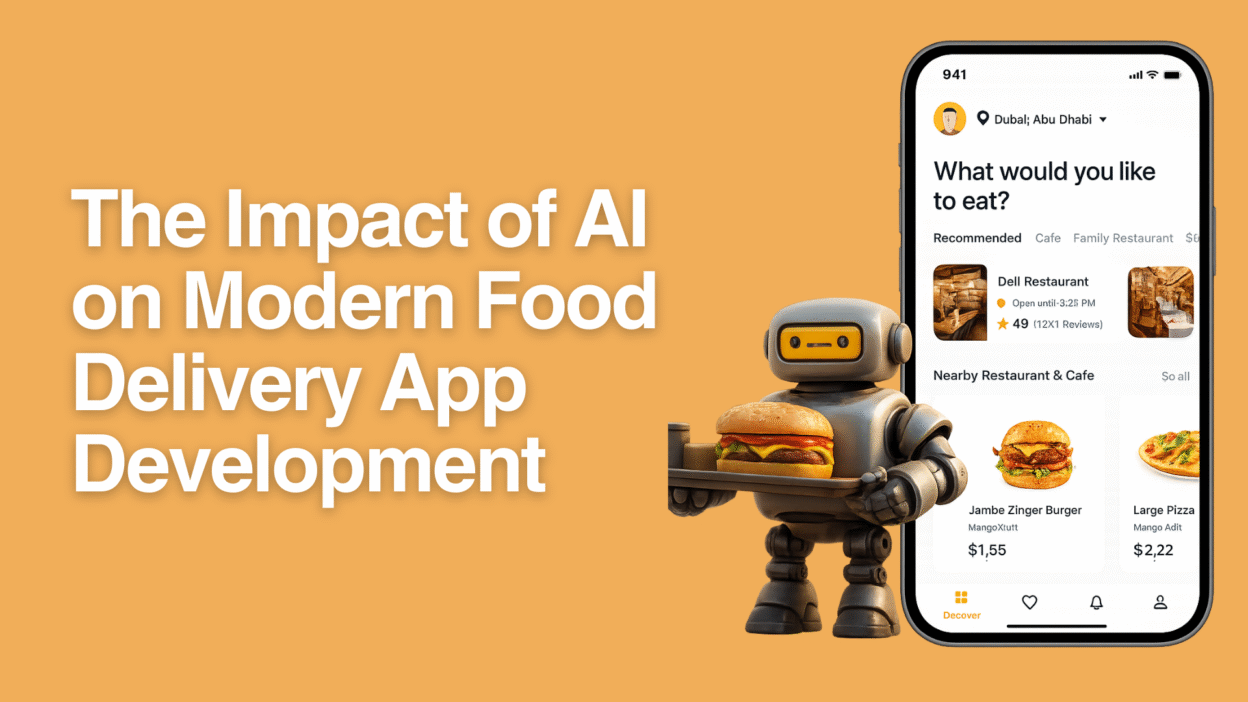
In the past few years, the food delivery industry has undergone a massive digital transformation. What was once a simple “order and deliver” process has now evolved into a highly automated, data-driven ecosystem, and at the heart of this evolution lies Artificial Intelligence (AI).
From personalized recommendations and predictive analytics to smart route optimization and real-time tracking, AI has completely redefined how food delivery apps function. Brands like Zomato, Swiggy, Uber Eats, and DoorDash have already leveraged AI to make their platforms faster, smarter, and more customer-centric.
In this article, we’ll explore how AI is impacting modern food delivery app development, what benefits it offers, the key technologies involved, and how businesses can harness its power with the right development partner like AV Technosys.
1. The Evolution of Food Delivery Apps
Before diving into AI, let’s understand how the industry evolved:
- Early Phase: Initially, food delivery apps were simple aggregators where users selected restaurants, placed orders, and waited for deliveries.
- Intermediate Phase: Integration of GPS, digital payment systems, and customer reviews brought more convenience.
- Modern Phase: Now, AI and machine learning (ML) have taken center stage, enabling predictive behavior, smart logistics, and voice-enabled ordering.
This shift has been driven by the demand for speed, personalization, and convenience, three pillars that AI perfectly supports.
2. Why AI Matters in Food Delivery App Development
AI empowers food delivery platforms to go beyond basic functionality. Instead of just connecting restaurants to customers, AI enables a food delivery app development company to create intelligent systems capable of understanding, predicting, and optimizing user experiences for both businesses and customers alike.
Here’s why it’s so impactful:
- Data-Driven Insights: AI analyzes vast amounts of user and operational data to make accurate business decisions.
- Enhanced Customer Experience: Personalized menus, discounts, and order suggestions improve satisfaction and loyalty.
- Operational Efficiency: From inventory to delivery, every step becomes more efficient through automation and predictive algorithms.
3. Core Applications of AI in Food Delivery Apps
Let’s explore how AI is transforming different layers of the food delivery ecosystem:
a. Personalized Recommendations
AI algorithms analyze a user’s previous orders, search patterns, dietary preferences, and even the time of day to suggest relevant dishes or restaurants.
Example: If someone frequently orders vegetarian meals, the app’s AI system prioritizes similar cuisines and offers related promotions.
Benefit: Increases average order value and customer retention.
b. Predictive Ordering and Demand Forecasting
AI can predict when a customer is likely to place their next order or when certain dishes will trend based on time, season, or events.
For restaurants and delivery services, this helps manage:
- Ingredient inventory
- Kitchen preparation
- Driver availability
Benefit: Reduced waste, faster deliveries, and higher operational efficiency.
c. Smart Route Optimization
AI combines GPS data, traffic insights, and delivery density to assign the best possible route for riders.
It can also dynamically adjust routes if traffic conditions change or new orders come in nearby.
Benefit: Faster deliveries, reduced fuel costs, and better customer satisfaction.
d. Chatbots and Virtual Assistants
AI-powered chatbots now handle customer queries, order tracking, refund requests, and even complaints without human intervention.
They use Natural Language Processing (NLP) to understand human intent and respond instantly.
Benefit: 24/7 support and reduced operational costs.
e. Dynamic Pricing
AI models evaluate market demand, delivery distance, restaurant location, and time to calculate dynamic delivery charges.
This ensures fair pricing while maintaining profit margins during peak hours.
Benefit: Balanced customer satisfaction and profitability.
f. Image Recognition and Visual Search
AI can identify dishes from photos uploaded by users and suggest where to order similar meals.
This feature is increasingly popular among social-media-driven audiences who want to “order what they see.”
Benefit: Enhanced user engagement and visual appeal.
g. Fraud Detection and Security
AI-based systems monitor transactions in real-time to detect fraudulent payments or fake accounts.
Machine learning algorithms recognize unusual activity patterns and instantly flag them for review.
Benefit: Improved app security and brand credibility.
h. Voice Recognition for Ordering
With AI-driven voice assistants (like Siri, Alexa, or Google Assistant), customers can order food hands-free.
For example, “Hey Google, order my usual pizza from Domino’s.”
Benefit: Streamlined and futuristic ordering experience.
4. The AI Technologies Powering Modern Food Delivery Apps
Here are the core AI technologies that developers integrate into modern food delivery apps:
| Technology | Functionality |
| Machine Learning (ML) | Learns from user behavior to provide personalized recommendations. |
| Natural Language Processing (NLP) | Enables chatbots and voice assistants to understand human queries. |
| Predictive Analytics | Forecasts demand, sales trends, and delivery volumes. |
| Computer Vision | Recognizes food images, menus, and packaging for automation. |
| Robotic Process Automation (RPA) | Handles repetitive backend operations like order assignment. |
When integrated strategically, these AI technologies ensure speed, scalability, and superior user experiences.
5. Benefits of AI Integration in Food Delivery Apps
a. Better Customer Engagement
AI personalizes app content, improving engagement through loyalty programs, push notifications, and meal suggestions.
b. Reduced Delivery Time
With route optimization and predictive logistics, delivery times drop significantly.
c. Improved Restaurant Management
AI analytics help restaurants plan menus, control costs, and manage staff based on demand forecasts.
d. Enhanced Decision-Making
Real-time dashboards powered by AI give businesses accurate insights into what’s working and what’s not.
e. Cost Efficiency
Automating manual tasks reduces labor costs and human error, increasing profitability.
6. Case Studies: How Leading Brands Use AI
- Zomato: Uses AI for customer behavior analysis and menu recommendations.
- Swiggy: Employs ML algorithms for real-time order assignment and route optimization.
- Uber Eats: Integrates AI to forecast delivery times and optimize courier dispatch.
- Domino’s: Uses predictive analytics to prepare orders before they’re even placed during high-demand hours.
These examples show how AI has become the backbone of leading food delivery platforms worldwide.
7. Steps to Build an AI-Driven Food Delivery App
If you’re planning to launch or upgrade your food delivery platform, here’s the typical development roadmap:
- Define Your App’s Goals — Identify what problems AI will solve (recommendations, routing, etc.).
- Data Collection and Integration — Gather user, restaurant, and delivery data securely.
- Choose the Right AI Model — Depending on your focus (ML for predictions, NLP for chatbots, etc.).
- Develop Core Features — Food catalog, real-time tracking, payment gateway, and AI-driven dashboard.
- Testing and Optimization — Continuously train the AI models for better performance.
- Launch and Monitor — Use analytics to enhance UX and operational efficiency.
Partnering with a reliable AI app development company like AV Technosys ensures your project benefits from technical expertise, scalable architecture, and industry best practices.
8. Challenges in Implementing AI
Despite its benefits, integrating AI into food delivery apps isn’t without challenges:
- Data Privacy Concerns: Managing sensitive user data requires strong encryption and compliance with GDPR/CCPA.
- High Development Costs: AI models need quality data and training, which can increase initial investment.
- Integration Complexity: Aligning AI tools with existing systems demands skilled developers.
- Continuous Learning: AI models must be retrained regularly as market trends evolve.
A professional team like AV Technosys helps mitigate these challenges through strategic planning, robust architecture, and long-term support.
9. The Future of AI in Food Delivery
The next wave of AI in the food delivery sector will focus on hyper-personalization, autonomous delivery, and predictive ecosystem design.
Here’s what we can expect soon:
- Drone and Robot Deliveries powered by AI for last-mile automation.
- Emotion-based Recommendations analyzing tone, mood, or facial expressions for meal suggestions.
- Zero-Click Ordering, where AI predicts and places your favorite order automatically.
- AI-Driven Sustainability, optimizing delivery routes and packaging for eco-friendly operations.
As AI evolves, food delivery apps will become smarter, greener, and more human-like in understanding consumer needs.
Conclusion
AI is no longer an optional upgrade; it’s the foundation of modern food delivery app development.
From smart recommendations to efficient logistics and predictive insights, AI is helping businesses deliver more, faster, and smarter.
For companies looking to stand out in this competitive space, partnering with an experienced development firm like AV Technosys can make all the difference.
With expertise in AI integration, app design, and scalable architecture, AV Technosys helps transform your idea into a powerful, intelligent delivery platform built for the future.
FAQs
Q1. How is AI used in food delivery apps?
AI is used for personalized recommendations, route optimization, chatbots, predictive ordering, and demand forecasting in food delivery apps.
Q2. Can AI improve delivery speed?
Yes. AI algorithms analyze traffic, location, and order density to assign the best routes, reducing delivery time significantly.
Q3. Is AI integration expensive for startups?
While initial costs are higher, AI quickly boosts ROI through automation, efficiency, and customer retention.
Q4. What’s the future of AI in food delivery?
Future trends include AI-driven drones, autonomous deliveries, emotion-based recommendations, and zero-click ordering systems.
Q5. Why choose AV Technosys for AI app development?
AV Technosys offers expert developers, custom AI models, and end-to-end app solutions tailored for scalability, performance, and business growth.